
Chapter 3
The Beicheng Broadcasting Tower stood along Ren’ai Road like a colossal, silent gray tombstone, arrogantly overlooking a city shivering beneath winter rain.
1:50 p.m.
Song Xingran stood in the lobby on the mirror-polished marble floor. The down jacket she wore hadn’t fully dried yet, carrying the damp scent of rainwater—completely out of place amid the aroma of premium coffee and the sterile dryness of air-conditioning.
She clutched the temporary access pass tightly in her hand. Its edges had softened slightly, soaked by the cold sweat in her palm. The lobby’s air-conditioning was set aggressively low—designed to protect expensive equipment—but it made her shiver. This wasn’t the damp cold outside; it was a precise, mechanical chill, devoid of any human warmth.
“Studio A is on the eighteenth floor. Turn left at the elevators and go all the way down. That area belongs exclusively to Teacher Shen. Unauthorized personnel are not allowed to linger.”
The receptionist’s makeup was flawless. Her voice was sweet, yet perfectly standardized—like an AI. As she handed over the pass, her gaze resembled that of someone watching a condemned prisoner walk toward execution.
Song Xingran thanked her stiffly and turned toward the elevator.
The moment the metal doors closed, a wave of weightlessness hit her, her stomach twisting. The red digital numbers climbed floor by floor, like a countdown to the last moments of her freedom.
Ding.
Eighteenth floor.
The doors slid open, and a near-dead silence rushed toward her.
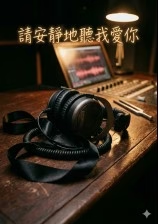
Unlike the bustling noise of the lower floors, this level was eerily quiet. Thick, dark-gray soundproof carpeting swallowed every footstep. The walls were lined with wave-shaped acoustic panels—countless ears greedily absorbing every stray vibration in the air.
Song Xingran held her breath and stepped carefully forward. Even so, her heartbeat felt deafening—thump, thump, thump—coarse and intrusive in a space where even airflow seemed frozen.
At the end of the corridor stood a black soundproof door, so heavy it felt oppressive. No decoration, only a single brushed-metal letter:
A.
This was Shen Muchen’s domain.
A forbidden zone where, legend said, even flies dared not flap their wings.
She checked her watch.
1:58 p.m. Two minutes left.
Taking a deep breath, she tried to calm her heart, which felt ready to leap from her throat. Grab the item and leave, she told herself. Don’t stay a second longer. No matter how terrifying that man was, he wouldn’t eat her alive in a public building.
She reached out. Her fingertips touched the icy metal handle.
The cold shot up her nerves, making the collarbone she’d burned last night from “thermal radiation” ache faintly.
The door was heavy, yet it opened without a sound—the precision hydraulic hinges devouring all friction.
The moment Song Xingran stepped inside, an overwhelming pressure pinned her in place.
The studio lights were off.
In the vast space, only the control console glowed—rings of blue and amber indicators pulsing softly, like the cockpit of a deep-sea submarine, or the heart of some precise machine beating silently in the dark.
The air was biting cold—colder than outside—and unbearably dry. Her nasal passages tightened instantly; even breathing became an effort.
And Shen Muchen sat at the deepest point of that dim glow.
His back faced the door, seated in a sharp-lined ergonomic chair. He wasn’t wearing yesterday’s casual sweater. Instead, he had on a perfectly tailored black dress shirt. The sleeves were casually rolled to his elbows, revealing pale yet powerful forearms. On his wrist, an expensive mechanical watch ticked in an inaudible rhythm with the second hand.
No headphones. No script.
His eyes were gently closed as he spoke into the microphone he revered above all others in the industry—the legendary Neumann U87, known as the “Myth of Human Voice.”
“…At three thousand meters beneath the sea, there is no light, no warmth—only pressure, three hundred kilograms per square centimeter.”
The words Song Xingran had prepared—“Teacher Shen, I’m here to retrieve my things”—froze in her throat, dissolving into silent breath.
Because of his voice.
This wasn’t the mocking, humiliating tone from the tea room yesterday.
Nor the threatening voice that wielded temperature and static electricity in the alley.
At this moment, Shen Muchen seemed stripped of all human emotion—transformed into the deep sea itself.
His voice was pressed impossibly low, a subsonic resonance that bypassed hearing and vibrated directly through bone. Each word carried suffocating texture, like black seawater flooding over one’s head, filling the ears, crushing the eardrums—yet gentle enough to make one want to cry.
“…When the last blue whale breaches the surface, its fifty-two hertz call becomes the loneliest frequency on this planet. It calls out, but no one answers. It sings, but hears only its own echo.”
Song Xingran stood frozen in the doorway’s shadow.
As someone hypersensitive to sound, her hearing was ten times sharper than most—and so was her suffering. This world was unbearably loud to her: engines, voices, electrical hums, assaulting her nerves at all times.
But now—
Within this man’s voice, she felt an unprecedented sense of peace.
It was impossibly clean.
No breath noise.
No excess saliva.
Even the moment of vocal cord closure was flawless.
Like a vast sheet of soft black velvet, it isolated her from the chaos of the world, leaving only pure vibration that pierced straight into the soul.
So comfortable…
Her eyes grew warm.
She forgot her fear. Forgot her “debt.” Forgot even to breathe.
Like a traveler parched after days in the desert, stumbling upon clear spring water, she instinctively wanted to move closer—to drink more.
Without realizing it, she took a step forward.
Her shoe brushed the carpet with the faintest sound.
“Cut.”
The perfect voice stopped instantly.
Shen Muchen’s eyes snapped open.
The deep-sea melancholy vanished from his face, replaced by his usual icy sharpness. He pressed the stop button on the console—decisive, irritated by interruption.
Then he slowly turned his chair.
Those eyes—still piercing in the darkness—locked precisely onto the small, trembling figure at the door, like a radar system.
“Come in.”
Two words shattered Song Xingran’s immersion.
The suffocating pressure returned like a rising tide.
She jolted awake, lungs aching from prolonged breath-holding. Flustered, she shut the heavy door behind her with a click, sealing herself completely inside this dangerous chamber.
“Sh-Shen… Teacher Shen…” She hugged her bag like a guilty schoolchild and shuffled forward. “I’m here to get—”
“It’s exactly two o’clock.” Shen Muchen glanced at the console clock. His tone was flat. “You’re punctual.”
He wasn’t aggressive today. Instead, he resembled a god descending from an artistic sanctuary—aloof, weary, untouchable.
He casually picked up the recorder he’d confiscated overnight, along with the tangled white earphone cord.
Tap.
They slid across the mirror-smooth table and stopped before her.
“Take it.”
…Just like that?
Song Xingran stared in disbelief. She’d expected mockery, difficulty—maybe more humiliation. After all, he’d deliberately made her freeze outside for ten minutes yesterday.
She cautiously reached out. When her fingers touched the recorder’s icy metal shell, she flinched as if shocked, then grabbed it quickly—afraid he might change his mind.
“Thank you, Teacher Shen… I-I’ll go now?” she asked tentatively, her feet already angled toward the exit.
Shen Muchen didn’t answer.
He lifted his thermos and took a slow sip. The subtle sound of his Adam’s apple rolling echoed sharply in the silent studio—strangely intimate.
After setting the cup down, he still didn’t look at her. His gaze remained on the microphone as he asked, abruptly:
“You heard that just now?”
Song Xingran froze, then nodded. “I… I did.”
“How was it?” he asked casually, spinning the cup, as if discussing the weather—or conducting some inscrutable test.
She hesitated. Should she flatter him? Be professional? Say something impressive?
But under those deep eyes that seemed to pierce all lies, she blurted out the truth:
“It felt… lonely.”
The moment the words left her mouth, she regretted them.
Still, she bit her lip and added softly, “But it was beautiful. Like being surrounded by deep-sea water—oppressive, but… safe.”
The air froze.
Shen Muchen’s fingers stopped turning the cup.
He raised his eyes slowly. This time, the disdain was gone—replaced by sharp interest. A strange glint flickered in his gaze, like a hunter spotting rare tracks in the wilderness.
This clumsy reporter—who dropped her underwear in public and shivered in the rain—had understood Deep Sea’s narration. Not only that, she’d precisely grasped the emotion he had hidden beneath technique: loneliness coexisting with safety.
“Come here,” he said.
Alarm bells screamed in her head. “W-What for?”
He pointed at the red waveform pulsing on the screen.
“Do you know why I called ‘cut’?”
She shook her head. It had been flawless—no audible breath, no mistake.
“Because there was noise.”
Shen Muchen stood.
As he moved, the sharp scent of cedar closed in again, mingling with his dry body heat—forming an invisible wall around her. She instinctively retreated, only to hit the soundproofed wall behind her.
No escape.
He stopped thirty centimeters away.
A dangerous distance.
Not touching—yet close enough for heat to radiate, close enough for her to see her own panic reflected in his pupils.
“When you came in, the door angle was wrong. The airflow changed.”
He leaned down slightly. His voice softened—not cold now, but clinically strict, threaded with a subtle, seductive pull.
“And your breathing.”
His gaze dropped to her chest, rising and falling rapidly beneath thin silk fabric.
“Too chaotic.”
He reached out.
She shut her eyes in panic.
But he didn’t touch her.
His index finger traced an invisible line in the air, one centimeter above her collarbone.
The faint disturbance of air was like a blade across her nerves.
“Unstable frequency. Erratic breath,” he murmured, voice vibrating like a cello string. “Every inhale disrupts the sound field. Every exhale creates garbage noise.”
His finger drifted lower, hovering over her heart.
“Even your heartbeat—thump, thump, thump—is unbearably loud.”
Her face burned.
“I… I have rhinitis…” she whispered weakly.
Shen Muchen chuckled.
A short breath of laughter, hot against her forehead—absurdly intimate.
It was the first time she’d seen him smile. Mostly mockery, perhaps—but for a split second, the ice in his eyes cracked, revealing something dangerously alluring.
“Rhinitis?”
He leaned closer. This time, he touched her.
Cold fingertips pressed lightly to her brow.
It was like flipping a switch.
Her blood froze—then boiled.
“Song Xingran.”
The first time he’d spoken her full name. Low, slow, curling around the tongue like a spell.
“You’re sensitive enough to hear fifty-two hertz loneliness—yet you can’t control your own voice?”
“That’s not only disrespect to your profession.”
“It’s torture for my ears.”
He withdrew his hand. The loss of contact left burning heat behind.
Shen Muchen turned back to his chair and put on his headphones.
Once again, he became the cold tyrant—but the executioner’s tension was gone, replaced by the shame of expert critique… and an inexplicable urge to prove herself.
And a craving—for that voice.
“Since you’re here, don’t rush off.”
He adjusted the microphone without turning around.
“Come listen to a demo. If your ears are really as sharp as you claim… maybe you’ll be useful.”
An invitation.
And a trap.
Song Xingran tightened her grip on the recorder. Reason screamed at her to run—the door was right there.
But her feet wouldn’t move.
She stared at his focused silhouette in the dim light.
Lonely. Powerful. Perfect.
Like a siren in the deep sea, singing a fatal song.
She hesitated for three seconds.
Her phone vibrated in her pocket—Chen Ruolan’s催命 message.
A cliff behind.
An abyss ahead.
Song Xingran clenched her teeth and stepped forward, into Shen Muchen’s circle of light.
Behind her, the door closed—
silently,
completely.

Chapters
Comments
- Chapter 57 - A Note from Naiji: Before the Beginning of Part Two June 30, 2026
- Chapter 56 - Extra Chapter (4): The Fledgling in the Mirror June 30, 2026
- Chapter 55 - Extra Chapter (3): "See No Evil" in the Rearview Mirror June 30, 2026
- Chapter 54 - Extra Chapter (2): Office Afternoon Tea June 30, 2026
- Chapter 53 - Extra Chapter (1): Shen Muchen’s Midnight Shopping List June 30, 2026
- Chapter 52 - The Return — Shen Muchen’s Ultimate Complaint Letter June 30, 2026
- Chapter 51 - Recovery — The First Utterance June 30, 2026
- Chapter 50 - Promotion at 90 BPM June 30, 2026
- Chapter 49 - Guardian — The Fangs of the Little White Rabbit June 30, 2026
- Chapter 48 - Public Opinion Storm and Silent Counterattack March 3, 2026
- Chapter 47 - The Knot at Your Fingertips March 3, 2026
- Chapter 46 - The Vibrating Morse Code H March 3, 2026
- Chapter 45 - His eyes were cold and resolute March 3, 2026
- Chapter 44 - Silence: The Collapse of the Tower of Babel March 3, 2026
- Chapter 43 - The First Day of the Lunar New Year - Tenderness Between Legs March 3, 2026
- Chapter 41 - Baptism: The Tides in the Bathtub March 3, 2026
- Chapter 40 - Counterattack — The Fury of the Precision Instrument March 3, 2026
- Chapter 39 - This sound is so wet February 20, 2026
- Chapter 38 - Deep Sea: The Lonely Whale February 25, 2026
- Chapter 38 - Deep Sea: The Lonely Whale February 20, 2026
- Chapter 37 - Clamor: The Breaking Point February 25, 2026
- Chapter 37 - The Breaking Point February 20, 2026
- Chapter 36 - The Journey Home — Secrets Behind the Partition February 12, 2026
- Chapter 35.5 - The 90 BPM Collar February 12, 2026
- Chapter 35 - Purchasing Before New Year's Eve February 12, 2026
- Chapter 34 - Invitation: Tremolo Beneath the Piano Lid February 12, 2026
- Chapter 33 - After-School Exercise: Tongue Flexibility February 12, 2026
- Chapter 32 - Tenderness: “Normal” Lovemaking After Good Morning February 12, 2026
- Chapter 31.5 - 60 BPM Solo February 12, 2026
- Chapter 31 - Lesson One: Mirror Echo (H) February 12, 2026
- Chapter 30.5 - The Aftershock of 90 BPM — Taming the Vicious Dog February 12, 2026
- Chapter 30 - Establishment of Regulations: Red Lights and Supplementary Notices February 8, 2026
- Chapter 29 - Aftertaste: The Trojan Horse’s Placement February 8, 2026
- Chapter 28 - The First Night (Part 2): The Lover Out of Control February 8, 2026
- Chapter 27 - First Night (Middle): The Frequency of Pain and Happiness H February 8, 2026
- Chapter 26 - First Night (Part 1) — Unsealing Ceremony H February 8, 2026
- Chapter 25 - Tipping Point: Intolerable Craving Micro H February 8, 2026
- Chapter 24 - Temptation: Sketch of a Semi-Nude Micro H February 8, 2026
- Chapter 23 - Prelude: Choosing the “Instruments” February 8, 2026
- Chapter 22.5 - The 90 BPM Meeting: Secrets Under the Table February 8, 2026
- Chapter 22 - Work: Strictly Business in the Recording Studio February 5, 2026
- Chapter 21 - Making Up: A Punishment Dinner February 3, 2026
- Chapter 20 - The Argument: A Frequency Out of Control February 3, 2026
- Chapter 19 - Daily Life: Morning Kisses and Toothbrushes February 3, 2026
- Chapter 18 - A Date: Whispering in the Movie Theater (light R-18) February 3, 2026
- Chapter 17.5 - Static at 60 BPM February 3, 2026
- Chapter 17 - Secrets Behind the Black Curtain February 3, 2026
- Chapter 16.5 - 60 BPM: The First Encounter (Shen Mucheng’s POV) January 31, 2026
- Chapter 16 - Confession: A Contract of Sound January 31, 2026
- Chapter 15.5 - 60BPM Resonance January 29, 2026
- Chapter 15 - First Kiss: The Out-of-Control Pause Button January 29, 2026
- Chapter 14.5 - The Fall at 60 BPM January 29, 2026
- Chapter 14 - First Jealousy: The Trial Inside the Car January 29, 2026
- Chapter 13.5 - The Temptation of 90 BPM: Power and Submission January 29, 2026
- Chapter 13 - Sunlight and the Deep Sea January 29, 2026
- Chapter 12 - The Vanity Fair: A Frequency on the Brink of Losing Control January 28, 2026
- Chapter 11 - The First Time Holding Hands · The Airport as a Conductor of Heat January 28, 2026
- Chapter 10.5 - The 90 BPM Fallacy January 28, 2026
- Chapter 10 - Remote Withdrawal: 7,000 Kilometers of Intimate Whispers January 28, 2026
- Chapter 9 - Taken In on a Rainy Night: The Unfinished Forbidden Zone January 28, 2026
- Chapter 8 - L4: The One-Centimeter Pause Button January 28, 2026
- Chapter 7 - L3: Heat Convection Below Freezing January 26, 2026
- Chapter 6 - L2: Pelvic Resonance January 26, 2026
- Chapter 5 - The First Lesson — Deprivation and Obedience January 26, 2026
- Chapter 4 - Correction — A Touch Through the Air January 26, 2026
- Chapter 3 - The Broadcasting Tower — Low Frequencies in the Restricted Zone January 26, 2026
- Chapter 2 - Headphone Cable: Thermal Radiation Below Zero January 25, 2026
- Chapter 1 - Frequency Overload: He Is Not Human, He Is the Abyss January 25, 2026
Comments for chapter "Chapter 3"
MANGA DISCUSSION