
Chapter 37
The black Maybach came to a stop at the end of a rural road, like a dark ghost that had accidentally wandered into a tropical jungle. Old Chen respectfully opened the car door but immediately coughed as a rush of air hit him. The air was thick with the scent of burning straw, the sulfurous smell of cheap firecrackers, and the greasy aroma of scallions and garlic sizzling in hot oil.
Song Xingran stepped out, her high heels clacking against the uneven concrete. Before her eyes stretched a scene suffocatingly drenched in red.
It was a typical row house, but to celebrate Grandpa’s eightieth birthday, the family had blocked half the street and erected a massive red, blue, and white tent. Dozens of bright red plastic stools were packed tightly together like a sea of red, and the tables were covered in thin, tear-prone pink plastic tablecloths. At the front, a modified electronic parade float flickered with glaring neon lights, piled with enormous speakers blasting a heavy, slightly distorted Taiwanese EDM track.
Boom… boom… boom—
The low bass of the cheap sound system reverberated like muffled punches directly into Song Xingran’s diaphragm.
The vibrations traveled up from the soles of her feet, resonating with the lingering emptiness in her body from the car ride in a strangely terrifying way. She felt her uterus trembling in sync with the bass, a damp, ghostly sensation crawling along her inner thighs.
“So… this is where you grew up?” Shen Muchen stood beside her, still wearing his perfectly tailored black cashmere coat. Amidst the chaotic, colorful vitality of the countryside scene, he looked like an alien who had accidentally landed, completely out of place.
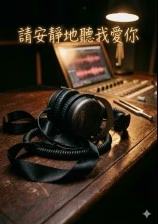
“Mm.” Song Xingran’s fingers fumbled inside her bag, brushing against the cold metal casing of her wired noise-canceling headphones. Her oxygen mask. With them on, the chaotic world would instantly go silent.
But she saw her mother busily carrying dishes in the distance and her father calling out to guests. That ingrained “good daughter” instinct froze her fingers. It was Grandpa’s birthday. Wearing headphones would be rude, unfit for the occasion, and her relatives would inevitably whisper that she “looked down on them after going to college.”
“Forget it.” She released her hand and, like a prisoner voluntarily walking to the execution ground, whispered to herself, “I’m the younger generation. I have to help.”
Shen Muchen looked down at her. Her face was pale as paper, yet she forced a stiff smile. He furrowed his brows, then reached out and grasped her cold fingers firmly. The warmth of his palm seeped into her.
“If you don’t want to smile, then don’t,” he whispered in her ear. “Let’s go. I’m here.”
Stepping into the tent, the sound wave instantly engulfed them. This wasn’t ordinary noise—it was a systematic assault on the auditory nerves.
“Oh! Xingran’s back!” “Is this your boyfriend? What does he do?” “Come on, call your third uncle! Why aren’t you calling anyone? You look so unfamiliar!”
Enthusiastic relatives swarmed around. The aunts’ loud voices rang like gongs in her ears; the uncles, reeking of alcohol, leaned in to push wine, their shouts vibrating her eardrums; and children darted between tables, their plastic toys emitting shrill beeps.
Song Xingran felt like a fish thrown into a spin dryer. “Hello, Uncle… Hello, Aunt…” Her voice trembled, and spots of light flickered at the edges of her vision—early signs of a migraine.
Shen Muchen stayed half a step to her side, a black shield protecting her from most of the sweat-and-alcohol-laden pushing. Polite but distant, he responded to the relatives’ questions. His natural air of authority silenced even those who had been ready to tease her under the influence of alcohol.
Finally, they sat. The table was loaded with red crab rice cakes, Buddha jumps over the wall soup, steamed grouper… the smell was overwhelming. Song Xingran’s hand shook, unable to lift even a single peanut.
On the stage, the host of the electronic float grabbed a malfunctioning microphone. “Ssshh—!!” A piercing high-frequency screech cut through the air.
“Clang!” The chopsticks in Song Xingran’s hand fell to the table. For a moment, it felt as if a steel rod had pierced her eardrum, her vision went black, and her stomach convulsed violently.
“Just hold on,” Shen Muchen said, pressing his large hand over her trembling one beneath the tablecloth. With the other, he placed a piece of crab meat into her bowl in a low, steady voice: “Eat something. Low blood sugar makes you more sensitive to sound.”
Mechanically, she opened her mouth and swallowed. She tasted nothing, only felt like a string stretched to its breaking point, ready to snap at any moment.
The last straw came during the cake-cutting ceremony. The host shouted hoarsely into the broken microphone:
“Sound engineer! Turn up the music! Let’s wish Grandpa Song—Fortune as vast as the ocean! Longevity as high as the mountains!”
The crowd rose, applauding thunderously. Simultaneously, two long strings of firecrackers ignited on either side of the stage.
Crackling—boom! Boom!
The explosions reverberated inside the semi-enclosed tent, the sound waves unable to dissipate, bouncing and stacking in the confined space. The thick smoke from the gunpowder filled the air instantly, making it hard to keep eyes open.
This was no longer sound. It was a bombardment. A deafening “buzz” exploded in Song Xingran’s head; the world warped completely. All other sounds vanished, replaced by a monotonous, piercing tinnitus screaming like an alarm. Her vision shook violently, red tables and chairs and the noisy crowd twisting into a nauseating blur.
She stood abruptly. The chair scraped the floor, but no one noticed over the firecrackers. She didn’t faint. Compared to passing out, staying conscious to endure this was the cruelest torment.
She clutched the edge of the table, knuckles white, cold sweat soaking her back. She could not collapse. Falling would be a disgrace. From childhood, she had learned only one survival rule: endure.
But she couldn’t take it anymore. She turned to Shen Muchen. Those usually clear eyes were now glazed, filled with raw animalistic fear and pleading. Tears welled up but wouldn’t fall.
“Shen Muchen…” She mouthed, her voice broken and swallowed by the firecrackers. He understood: she was asking for help.
His heart tightened sharply. Seeing her teetering, her soul seemingly torn from her body, was more infuriating and heart-wrenching than anything else.
Without hesitation, he rose, strode forward, and wrapped her half in his arms. Using his cedar-scented coat, he enveloped her shivering body.
He lifted his head, eyes sharp as blades, scanning the surrounding relatives oblivious to Song Xingran’s suffering. Was this her family? This was their idea of celebration?
“Excuse us,” he said quietly, an authority without anger. Without explanation or apology, he placed one hand over her ear on the outside, pressing her head to his chest, the other hand holding her waist, supporting her entire weight.
“Close your eyes,” he whispered near her remaining ear, voice steady as a mountain. “Don’t listen. Don’t look. Come with me.”
Amid the watchful eyes and deafening firecrackers, he shielded her like a priceless object ready to shatter, plowing through the crowd without looking back, rushing into the row house.
Shen Muchen carried her into the front door. The heavy iron door cut the clamor in half, though the powerful low-frequency vibrations still traveled along the terrazzo floor like countless hands clawing at their feet.
Inside, the light was dim, the air stagnant. The layout of this old Taiwanese row house was like a deep eel: only the ends received light, the middle always dark and damp. Shen Muchen didn’t stop, carrying her through the cluttered living room and up the narrow, steep concrete staircase in the center.
The second floor was a long corridor, filled with the musty scent typical of old houses. Passing the street-facing master bedroom and a bathroom stacked with basins and plastic chairs, he reached the very end of the hallway.
There was a door with a faded Sailor Moon sticker. This was Song Xingran’s room, tucked in the corner, the edge of the house, the darkest place.
“Click.” Shen Muchen turned the cold lock with one hand and pushed the door open with his shoulder.
The room was small, the window facing a narrow, filthy fire lane, barely letting in light. Time had frozen here, and it had been forgotten. Against the wall, a bookshelf was crammed with yellowed romance novels and comics—the only escape from her barren childhood. Now, these memories had been violently encroached upon by reality.
Since she left home, the room had become the family’s “storage.” Dehumidifiers, out-of-season fans, boxes of unknown contents… they piled up like intruders, leaving only a narrow path to the single bed.
As Shen Muchen stepped in, he barely furrowed his brows. Dust. Sunlight streaming through the hallway revealed dense floating particles, like a gray mist swirling in the light—decades of accumulated dust and mites from neglected cleaning.
For someone like Shen Muchen, extremely sensitive to airborne irritants and normally requiring a negative-pressure ventilation system at home, the air was nearly toxic, scratching his throat instantly.
But he didn’t retreat. The person in his arms was still shaking.
“It’s… still so loud here…” Song Xingran murmured, curling into him. Even in the innermost room, the bass from the float still rattled the old aluminum windows. Her panicked eyes wandered the room, finally settling on the large old red wooden wardrobe occupying half the wall.
It had been her childhood refuge during her parents’ fights, relatives’ visits, or temple festivities.
“The wardrobe…” she clutched his coat, her voice broken, a maternal longing in her plea. “Go… in there… it has blankets… can’t hear…”
Shen Muchen glanced at the tightly closed, dust-filled carved door. He imagined the strong smell of camphor and mildew that would hit him when opened—a nightmare for his sensitive nose and fastidious nature.
Yet he looked down at the girl, already broken and desperate to hide. She wasn’t throwing a tantrum—she was asking for help.
“Alright.” He swallowed the itch in his throat, his voice hoarse yet gentle.
He carried her to the wardrobe, opened the door. A wave of stale air hit them, stacked with thick, old-fashioned blankets.
Shen Muchen didn’t mind. He held her, and like two refugees seeking shelter at the end of the world, they crawled into the dark, narrow, dusty, and musty wardrobe together.
The door closed. Darkness fell. The world was finally silent.

Chapters
Comments
- Chapter 57 - A Note from Naiji: Before the Beginning of Part Two June 30, 2026
- Chapter 56 - Extra Chapter (4): The Fledgling in the Mirror June 30, 2026
- Chapter 55 - Extra Chapter (3): "See No Evil" in the Rearview Mirror June 30, 2026
- Chapter 54 - Extra Chapter (2): Office Afternoon Tea June 30, 2026
- Chapter 53 - Extra Chapter (1): Shen Muchen’s Midnight Shopping List June 30, 2026
- Chapter 52 - The Return — Shen Muchen’s Ultimate Complaint Letter June 30, 2026
- Chapter 51 - Recovery — The First Utterance June 30, 2026
- Chapter 50 - Promotion at 90 BPM June 30, 2026
- Chapter 49 - Guardian — The Fangs of the Little White Rabbit June 30, 2026
- Chapter 48 - Public Opinion Storm and Silent Counterattack March 3, 2026
- Chapter 47 - The Knot at Your Fingertips March 3, 2026
- Chapter 46 - The Vibrating Morse Code H March 3, 2026
- Chapter 45 - His eyes were cold and resolute March 3, 2026
- Chapter 44 - Silence: The Collapse of the Tower of Babel March 3, 2026
- Chapter 43 - The First Day of the Lunar New Year - Tenderness Between Legs March 3, 2026
- Chapter 41 - Baptism: The Tides in the Bathtub March 3, 2026
- Chapter 40 - Counterattack — The Fury of the Precision Instrument March 3, 2026
- Chapter 39 - This sound is so wet February 20, 2026
- Chapter 38 - Deep Sea: The Lonely Whale February 25, 2026
- Chapter 38 - Deep Sea: The Lonely Whale February 20, 2026
- Chapter 37 - Clamor: The Breaking Point February 25, 2026
- Chapter 37 - The Breaking Point February 20, 2026
- Chapter 36 - The Journey Home — Secrets Behind the Partition February 12, 2026
- Chapter 35.5 - The 90 BPM Collar February 12, 2026
- Chapter 35 - Purchasing Before New Year's Eve February 12, 2026
- Chapter 34 - Invitation: Tremolo Beneath the Piano Lid February 12, 2026
- Chapter 33 - After-School Exercise: Tongue Flexibility February 12, 2026
- Chapter 32 - Tenderness: “Normal” Lovemaking After Good Morning February 12, 2026
- Chapter 31.5 - 60 BPM Solo February 12, 2026
- Chapter 31 - Lesson One: Mirror Echo (H) February 12, 2026
- Chapter 30.5 - The Aftershock of 90 BPM — Taming the Vicious Dog February 12, 2026
- Chapter 30 - Establishment of Regulations: Red Lights and Supplementary Notices February 8, 2026
- Chapter 29 - Aftertaste: The Trojan Horse’s Placement February 8, 2026
- Chapter 28 - The First Night (Part 2): The Lover Out of Control February 8, 2026
- Chapter 27 - First Night (Middle): The Frequency of Pain and Happiness H February 8, 2026
- Chapter 26 - First Night (Part 1) — Unsealing Ceremony H February 8, 2026
- Chapter 25 - Tipping Point: Intolerable Craving Micro H February 8, 2026
- Chapter 24 - Temptation: Sketch of a Semi-Nude Micro H February 8, 2026
- Chapter 23 - Prelude: Choosing the “Instruments” February 8, 2026
- Chapter 22.5 - The 90 BPM Meeting: Secrets Under the Table February 8, 2026
- Chapter 22 - Work: Strictly Business in the Recording Studio February 5, 2026
- Chapter 21 - Making Up: A Punishment Dinner February 3, 2026
- Chapter 20 - The Argument: A Frequency Out of Control February 3, 2026
- Chapter 19 - Daily Life: Morning Kisses and Toothbrushes February 3, 2026
- Chapter 18 - A Date: Whispering in the Movie Theater (light R-18) February 3, 2026
- Chapter 17.5 - Static at 60 BPM February 3, 2026
- Chapter 17 - Secrets Behind the Black Curtain February 3, 2026
- Chapter 16.5 - 60 BPM: The First Encounter (Shen Mucheng’s POV) January 31, 2026
- Chapter 16 - Confession: A Contract of Sound January 31, 2026
- Chapter 15.5 - 60BPM Resonance January 29, 2026
- Chapter 15 - First Kiss: The Out-of-Control Pause Button January 29, 2026
- Chapter 14.5 - The Fall at 60 BPM January 29, 2026
- Chapter 14 - First Jealousy: The Trial Inside the Car January 29, 2026
- Chapter 13.5 - The Temptation of 90 BPM: Power and Submission January 29, 2026
- Chapter 13 - Sunlight and the Deep Sea January 29, 2026
- Chapter 12 - The Vanity Fair: A Frequency on the Brink of Losing Control January 28, 2026
- Chapter 11 - The First Time Holding Hands · The Airport as a Conductor of Heat January 28, 2026
- Chapter 10.5 - The 90 BPM Fallacy January 28, 2026
- Chapter 10 - Remote Withdrawal: 7,000 Kilometers of Intimate Whispers January 28, 2026
- Chapter 9 - Taken In on a Rainy Night: The Unfinished Forbidden Zone January 28, 2026
- Chapter 8 - L4: The One-Centimeter Pause Button January 28, 2026
- Chapter 7 - L3: Heat Convection Below Freezing January 26, 2026
- Chapter 6 - L2: Pelvic Resonance January 26, 2026
- Chapter 5 - The First Lesson — Deprivation and Obedience January 26, 2026
- Chapter 4 - Correction — A Touch Through the Air January 26, 2026
- Chapter 3 - The Broadcasting Tower — Low Frequencies in the Restricted Zone January 26, 2026
- Chapter 2 - Headphone Cable: Thermal Radiation Below Zero January 25, 2026
- Chapter 1 - Frequency Overload: He Is Not Human, He Is the Abyss January 25, 2026
Comments for chapter "Chapter 37"
MANGA DISCUSSION