The black Maybach stopped at the end of the country road, like a ghost mistakenly wandering into a tropical jungle. Old Chen respectfully opened the door, but as it swung open, he coughed lightly, choked by the flood of air that rushed in. The air carried the sharp scents of burning straw, cheap fireworks’ sulfur, and the greasy smoke of onions and garlic sizzling in hot oil.
Song Xingran stepped out of the car, her high heels clicking on the uneven concrete. What greeted her eyes was a suffocating sea of red.
It was a typical row house. To celebrate her grandfather’s eightieth birthday, the family had blocked off half the street and erected a huge red, blue, and white canopy. Dozens of bright red plastic stools were arranged tightly together, forming a vast ocean of crimson. The tables were covered with cheap, tear-prone pink plastic tablecloths. At the front, a modified electronic parade float blinked with glaring neon lights, stacked with huge speakers blasting pulsing, slightly distorted Taiwanese electronic dance music.
Boom… boom… boom—
The heavy bass, so typical of cheap sound systems, hit like muffled punches against Song Xingran’s diaphragm. The vibrations traveled up through her feet, resonating in a strange and frightening way with the lingering emptiness left in her body from the car ride. She felt as if her womb itself were shaking with the bass, a wet, ghostly sensation entwining her inner thighs.
“This… is where you grew up?” Shen Mucheng stood beside her, still clad in his meticulously tailored black cashmere coat. Against this vibrant yet chaotic rural backdrop, he seemed like an alien, entirely out of place.
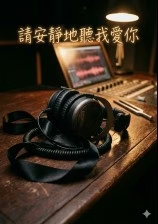
“Mm.” Song Xingran’s fingers fumbled in her bag, brushing against the cold metal of her wired noise-canceling headphones. Her lifeline. Once on, the clamor of the world could be muted with a single press.
But she saw her mother busy carrying dishes, her father loudly calling out to guests. The ingrained “good daughter” instincts in her bones froze her fingers. It was her grandfather’s birthday. Wearing headphones would be rude. Uncooperative. It would earn her relatives’ whispers: “Went to college, now looking down on everyone.”
“Forget it.” She released her hand, like a prisoner willingly walking onto the execution platform, whispering to herself, “I’m the junior. I need to help.”
Shen Mucheng looked down at her. He saw the pale girl forcing a stiff smile despite her ghostly face. He furrowed his brows, then reached out and clasped her icy fingers. His warmth flowed steadily into her.
“If you don’t want to smile, don’t,” he murmured in her ear. “Let’s go. I’m here.”
They stepped under the canopy, and the sound immediately engulfed them. This was not ordinary noise—it was a collective assault on the auditory nerves.
“Ah! Xingran is back!” “Is this your boyfriend? What does he do?” “Come, call Third Uncle! Why so unfamiliar?”
Relatives swarmed them. Loud aunts and older women’s voices struck like gongs in her ears; drunken uncles pressed in, shouting to get her to drink, their voices rattling her eardrums; screaming children darted between tables, plastic toys beeping sharply.
Song Xingran felt like a fish thrown into a spin dryer. “Hello, Uncle… Hello, Aunt…” Her voice trembled, and spots of light began to appear at the edges of her vision—a precursor to a migraine.
Shen Mucheng remained at her side, a black barrier shielding her from most of the sweat- and alcohol-scented pushes. He answered relatives politely but distantly. His innate aura of authority caused even the loudest family members to fall silent.
Finally, they took their seats. The table overflowed with red crab rice cakes, Buddha jumps over the wall soup, steamed grouper… the aroma thick enough to overwhelm. Song Xingran held her chopsticks, but her hands trembled too much to pick up a single peanut.
On stage, the host picked up a faulty microphone. “Ssss—!!” A piercing high-pitched squeal cut through the air.
Clang!
The chopsticks fell from her hands. In that instant, it felt as if a steel pin had pierced her eardrums, sending her vision black and her stomach into violent spasms.
“Hold on a little longer.” Beneath the table, Shen Mucheng’s large hand covered hers, steadying her trembling. With the other hand, he placed a piece of peeled crab meat into her bowl. His voice was low and calm. “Eat something. Low blood sugar makes you more sensitive to sound.”
Mechanically, Song Xingran opened her mouth and swallowed. She could taste nothing—she felt like a piano string stretched to the breaking point, ready to snap at any moment.
The final straw came during the cake-cutting. The host, voice hoarse, screamed through the broken microphone:
“Sound engineer! Music, drop it! Let’s wish Grandpa Song—longevity as the East Sea, happiness as the South Mountain!”
The crowd cheered and stood up. Firecrackers on either side of the stage ignited.
Crack! Boom! Boom!
The explosions reverberated in the semi-enclosed canopy. The sound waves could not disperse, only reflecting and amplifying within the confined space. Dense gunpowder smoke filled the air, making eyes water.
This was no longer sound—it was bombardment. Song Xingran’s brain rang with a deafening “buzz,” and the world completely distorted. All sounds vanished, leaving only the shrill, unrelenting tinnitus, like a siren screaming madly. Her vision wobbled violently, red tables and the chaotic crowd twisting into nauseating blobs of color.
She abruptly stood. The chair scraped against the floor with a grating sound, but amidst the firecrackers, no one noticed. She did not faint. Compared to passing out, enduring this while fully conscious was the crueler torment.
Her knuckles whitened as she gripped the table edge, cold sweat soaking her back. She could not collapse. Falling would be disgraceful. It would shame her grandfather. Her only survival rule had always been endurance.
But she could not do it. She turned to Shen Mucheng. His eyes, normally clear, were now scattered, filled with raw fear and pleading instinct. Tears welled up but could not fall.
“Shen Mucheng…” Her voice broke, lost in the firecracker roar. But he read her lips. She was saying: Save me.
Shen Mucheng’s heart clenched. Seeing her fragile, soul-seemingly ripped away like this made him angrier and more heartbroken than ever.
Without hesitation, he rose, strode over, and wrapped her in his arms. He enveloped her trembling body in his cedar-scented coat.
He raised his head, eyes cold as knives, scanning the frenzied relatives around them. This is her family? This is supposed to be celebration?
“Excuse us.” His voice was quiet, yet commanded an undeniable authority. He didn’t explain or apologize—he simply placed a hand firmly over her outer ear, pressing her head to his chest, and with the other hand hugged her waist, supporting her entire weight.
“Close your eyes,” he whispered in her ear, calm as a mountain. “Don’t hear. Don’t see. Come with me.”
In full view of everyone, through the deafening firecrackers, he protected her like a fragile treasure and pushed through the crowd, entering the house without looking back.
Shen Mucheng carried Song Xingran into the ground floor of the row house. The heavy iron door cut off some of the chaos outside, but the penetrating low-frequency vibrations still traveled through the terrazzo floor, like countless hands scratching at their feet.
The indoor light was dim, the air stagnant. In old Taiwanese long houses, the layout was like a deep eel, lit only at the ends, always dark and damp in the middle. Shen Mucheng didn’t stop. He carried her across the cluttered living room, up the narrow, steep concrete staircase in the center of the house, and swiftly to the second floor.
The second floor was a long corridor, filled with the musty smell unique to old homes. Passing the master bedroom facing the street and a bathroom stacked with basins and plastic chairs, Shen Mucheng reached the far end.
A wooden door bore a faded Sailor Moon sticker. This was Song Xingran’s room—hidden in the farthest, darkest corner of the house.
Click. Shen Mucheng freed one hand to turn the cold lock, nudging the door open with his shoulder.
The room was small. Its window faced a narrow, filthy fire escape, barely letting in any light. Time had frozen this space—it had been forgotten. Bookshelves were crammed with yellowed romance novels and manga, the only escape of her meager childhood. But now, reality had violently invaded them.
Since she left home, the room had become a storage closet. Dehumidifiers, out-of-season fans, and boxes of unknown items stacked like intruders, leaving only a narrow path to the single bed.
As soon as Shen Mucheng stepped in, his brows subtly furrowed. Dust. In the light streaming from the corridor, countless dust particles floated, like a gray mist dancing in the air. For someone as sensitive as him, used to negative-pressure ventilation at home, this was a gas chamber. His throat itched almost instantly.
But he didn’t retreat. Because the person in his arms was still shaking.
“It’s… still so noisy…” Song Xingran curled into him. Even in the innermost room, the bass from the electronic float rattled the old aluminum window frames. Her fearful gaze locked on the old red-wood wardrobe taking up half a wall.
It had been her refuge as a child, hiding from her parents’ fights, visiting relatives, and temple celebrations.
“Wardrobe…” she clutched his collar, voice broken, an almost primal insistence. “Go… inside… blankets… can’t hear…”
Shen Mucheng looked at the tightly shut, dust-filled cabinet. He imagined the overwhelming smell of camphor and mildew upon opening it—an assault to his senses.
Yet he looked down at the girl, utterly broken, seeking refuge. She wasn’t being unreasonable—she was begging for help.
“Okay.” He swallowed the itch in his throat, voice hoarse yet gentle.
He carried her to the wardrobe, pulled open the doors. A wave of musty air hit them. Thick, old-fashioned blankets filled the space.
Shen Mucheng didn’t flinch. He held her as two refugees seeking shelter at the end of the world, sliding into the dark, narrow wardrobe filled with dust and mildew.
The door closed. Darkness fell. Finally, the world was silent.


Comments for chapter "Chapter 37"
MANGA DISCUSSION